
AI Won’t Fix Your Go-to-Market Motion. But It Will Expose It.
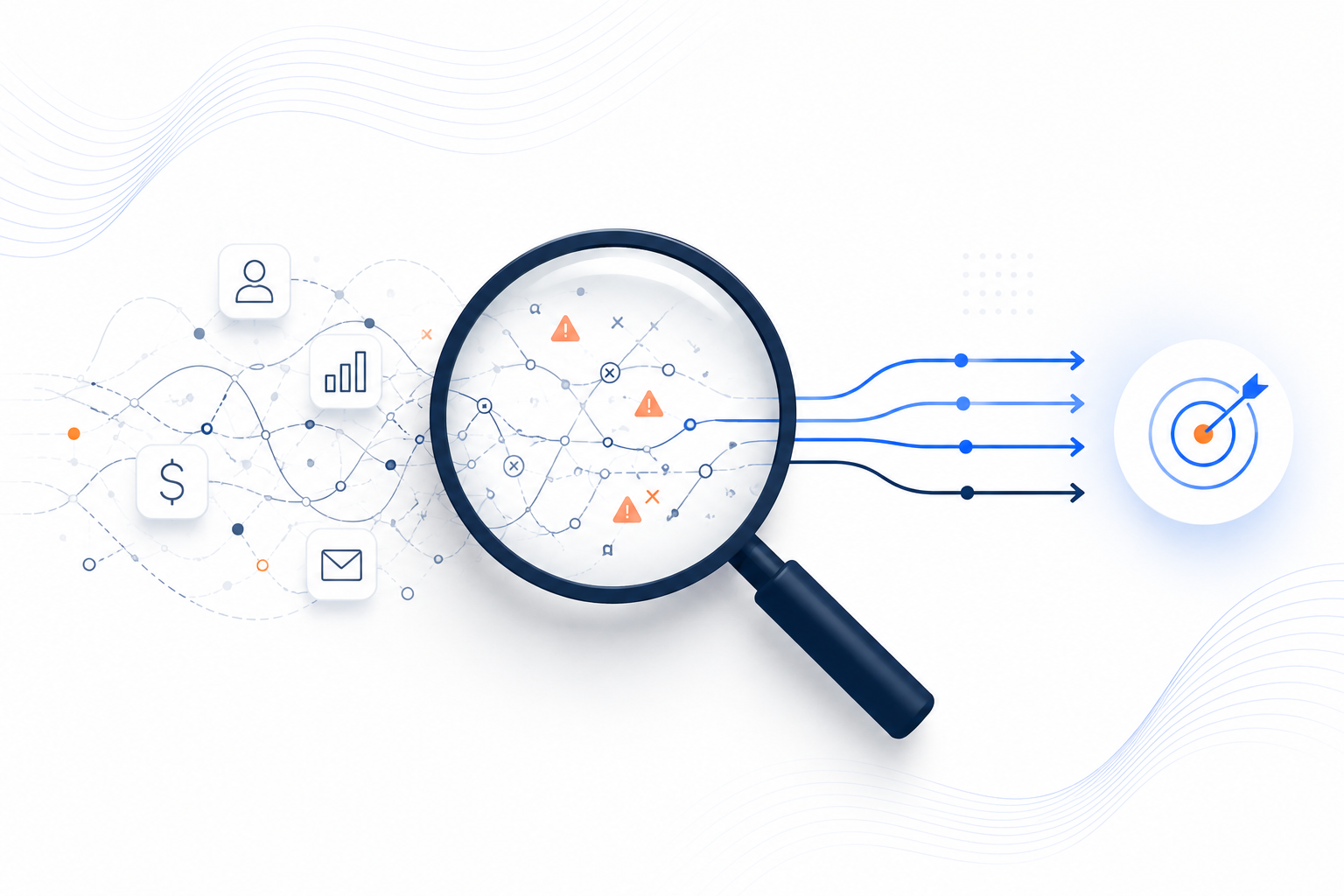
The biggest opportunity isn’t adding AI to commercial work. It’s redesigning commercial work around what humans and machines each do best.
AI is moving into almost every part of the commercial organization.
Prospecting.
Research.
Account planning.
Content.
CRM.
Forecasting.
Customer intelligence.
Proposal development.
Sales enablement.
Partner management.
Analytics.
And increasingly, autonomous agents that can execute entire workflows rather than simply assist with individual tasks.
The potential is enormous.
But there’s a problem.
Automating a bad commercial motion doesn’t make it good.
It makes it faster.
We are automating workflows we never designed
A lot of commercial processes weren’t actually designed.
They accumulated.
A CRM field was added because someone needed a report.
An approval step was created because of one bad deal.
A weekly meeting exists because it has always existed.
Salespeople manually research accounts because information lives in six different systems.
Marketing produces material sales doesn’t use.
Customer knowledge sits in call transcripts nobody reviews.
Managers spend hours collecting information that already exists somewhere else in the organization.
Then AI arrives.
And the first instinct is often:
Where can we add an agent?
I think there’s a better question:
If we were designing this commercial motion today, knowing what AI can do, would we build it this way at all?
Often, the answer is no.
AI exposes operational debt
One of the most interesting things about AI is that it makes inefficient processes easier to see.
If an agent can’t determine which accounts matter because the ICP isn’t clear, that’s useful information.
If an AI system can’t produce a reliable proposal because pricing changes constantly, that’s useful information.
If customer intelligence can’t be synthesized because information is fragmented across systems, that’s useful information.
If automated prospecting generates enormous volumes of mediocre outreach, that tells you something about targeting and positioning.
If a sales copilot gives inconsistent recommendations because the organization itself hasn’t agreed on the sales process, the technology isn’t necessarily the problem.
AI often reveals the ambiguity that humans have been compensating for.
Don’t automate ambiguity
Commercial organizations run on a mixture of structured processes and human judgment.
The trick is understanding which is which.
There are tasks machines can increasingly perform extraordinarily well:
Gathering information.
Summarizing conversations.
Researching accounts.
Enriching records.
Identifying patterns.
Preparing meeting briefs.
Generating first drafts.
Monitoring signals.
Updating systems.
Routing information.
Executing repeatable workflows.
And there are decisions where experienced human judgment remains disproportionately valuable:
Which market should we enter?
Which customer is strategically important?
Should we change pricing?
Is this partnership worth pursuing?
What concession should we make to close a lighthouse account?
Is the customer’s objection real?
Should we walk away from this deal?
What does a subtle change in buyer behavior actually mean?
The goal shouldn’t be maximum automation.
It should be maximum leverage.
Start with the work, not the tool
This is why I think many AI transformations are starting in the wrong place.
Companies evaluate tools and then look for places to deploy them.
I’d reverse the sequence.
Start with the commercial motion.
Map the work.
Where does information enter the organization?
Where does it get lost?
Which tasks are repeated?
Which decisions require judgment?
Where are people waiting for information?
Where are people manually transferring information between systems?
Where does the same analysis get performed repeatedly?
Which activities create customer value?
Which activities exist because of legacy processes?
Then ask where technology can change the economics of that work.
That’s a much more interesting exercise than simply adding another AI application to the stack.
The future commercial organization will probably be smaller in some places and more capable
I don’t think the biggest impact of AI will be that every commercial role disappears.
I think roles will change.
A salesperson shouldn’t spend hours researching basic company information before a meeting.
A commercial leader shouldn’t need to manually assemble pipeline information from multiple systems.
A partnership executive shouldn’t spend half a day preparing background on a prospective partner.
A founder shouldn’t have to repeatedly explain the same customer context because the organization’s knowledge isn’t accessible.
Technology can handle more of that work.
That gives people more time for what remains difficult:
Judgment.
Relationships.
Negotiation.
Creativity.
Strategy.
Pattern recognition.
Decision-making under uncertainty.
The human role moves higher in the value chain.
This requires more than deploying AI
The companies that benefit most won’t necessarily be the ones with the most AI tools.
They’ll be the ones willing to redesign how commercial work happens.
That may mean eliminating workflows rather than automating them.
Changing roles.
Changing decision rights.
Connecting previously fragmented information.
Redesigning meetings.
Rebuilding account planning.
Creating new interfaces between sales, marketing, product, partnerships, and customer success.
And establishing clear boundaries between automated execution and human judgment.
I think of this as motion modernization.
Not digitizing the existing process.
Not adding AI everywhere.
Redesigning the commercial operating model around what is now possible.
Human judgment should become more valuable, not less
There is an understandable tendency to frame AI as replacing people.
I think that’s too simplistic, particularly in complex B2B commercialization.
The highest-value commercial decisions are rarely purely informational.
They’re contextual.
A system may identify that an opportunity has a low statistical probability of closing.
An experienced commercial leader may know that winning that particular customer changes the credibility of the entire company.
A model may recommend maintaining pricing discipline.
A leader may recognize that one strategic concession unlocks a market.
AI can dramatically improve the information available to make those decisions.
But information and judgment aren’t the same thing.
The best commercial organizations will combine them.
The question isn’t “Where can we use AI?”
That question is already becoming obsolete.
AI will be everywhere.
The more important questions are:
How should commercial work operate now?
What should machines do?
What should people do?
Where does human judgment create disproportionate value?
And how do we build a commercial system that improves as technology advances?
That’s the opportunity.
AI won’t fix a broken go-to-market motion.
But it may finally make the broken parts impossible to ignore.
And for companies willing to redesign rather than simply automate, that could be much more valuable.
Make moves that matter.